
I work on publisher monetisation. The idea that an ad slot can become a route to spying on people working for a publisher is hard to shrug off. We spend our time trying to make advertising support publishing. Here, researchers describe that same infrastructure being used against people inside a publishing organisation.
The Citizen Lab and Confiant published their investigations on 15 October. For today’s post, I want to stay with this one subject: AdFection, the technical chain behind it, and what I found in my own review of a MyIPInfo creative.
What the researchers established
Citizen Lab reports that Discover-Tech’s ad infrastructure was used to deliver Candiru spyware to devices at a publisher in 2024 and 2025, without requiring a click.
Its attribution combines network evidence with analysis of an implant recovered from a compromised Windows device. The network sequence moves from ad infrastructure to a validation server and then to spyware command-and-control infrastructure.
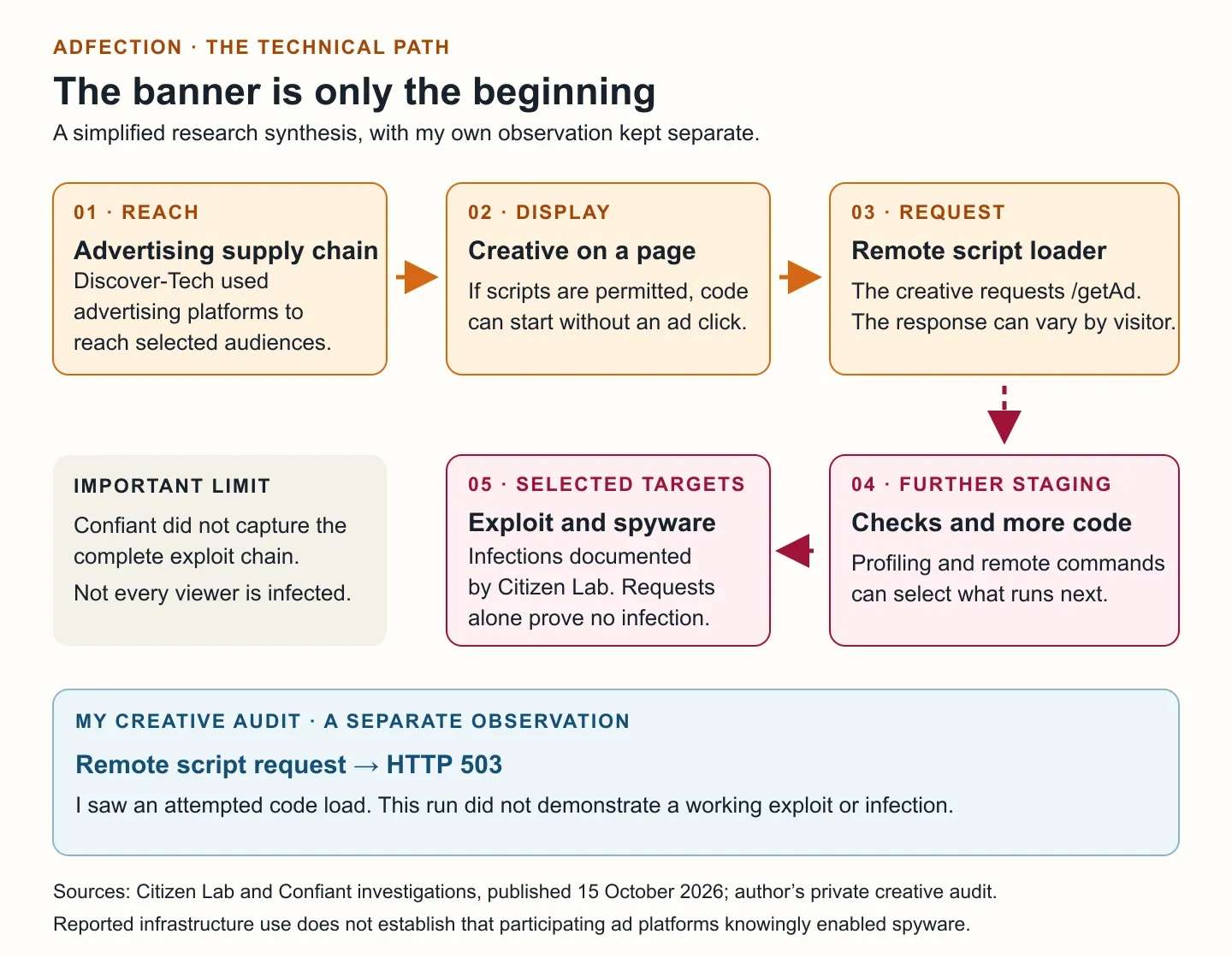
If the browser allows the creative’s scripts to execute, displaying the banner can start the delivery chain automatically. No ad click is needed. Whether that leads to infection depends on targeting and the subsequent attack chain. The presence of an ad or a callback alone does not establish that a device was compromised.
Sources: Citizen Lab — Exposing AdFection
How the delivery chain works
Confiant’s public technical analysis starts with an ordinary-looking banner that loads additional JavaScript. The ad’s request carries information about the device and impression. The response can vary according to who receives it, which makes a single creative screenshot a poor description of the actual behaviour.
In the chain Confiant examined, the next stage creates a tiny iframe and loads an obfuscated SDK. That SDK can collect browser and device characteristics, observe interactions available in its execution context, and communicate with an operator-controlled server. Such observations help distinguish a target from a scanner.
The operator can send encrypted instructions and additional JavaScript for the SDK to execute through new Function(...). Confiant describes separate encryption for collected results as well. Inspecting the initial tag therefore gives only part of the picture: important behaviour can arrive later.
That JavaScript still runs with the privileges of its browser context. Executing it is not, by itself, proof of an escape from the browser or of spyware installation. Confiant explicitly says it did not capture a complete exploit chain in the wild. Citizen Lab supplies the separate infection evidence.
For me, the security question starts before the final exploit. Who is allowed to choose the next code that a reader’s browser executes? If that choice sits behind a remote response that changes per visitor, approval of the initial file cannot settle the question for the lifetime of the campaign.
Sources: Confiant — public ADINT technical investigation
What my creative review showed
In my private MyIPInfo creative audit, I examined the creative’s source and a Chrome runtime capture. The ad frame was opened as a standalone document. The visible asset was a static 300×250 image. Its surrounding code also read document.cookie, requested detailed browser and platform properties, attempted an external IPv6 lookup, and constructed a remote script request.
The script URL included fields for those values. The code then appended a script element to the document, pointing to the /getAd service on ppv2.mtrtb[.]com, infrastructure also documented in the public research. These actions happened during loading; they did not depend on clicking the image. The click handler was a separate part of the creative.
In that run, the script service returned HTTP 503, another tracking host failed to resolve, and the IPv6 lookup failed. The cookie field was empty in the preview environment. I did not capture a working exploit or a device compromise. A 503 response cannot tell me whether a service was broken, deliberately withholding content, or unavailable for another reason.
What I can say is that the creative attempted collection and a further code load before any click. Its relationship to the wider surveillance operation comes from the researchers’ evidence. I would keep that distinction in any incident report, especially when the finding could affect a publisher’s response to a supplier.
I would also separate what a tag asks for from what it receives. A placeholder requesting an identifier is not proof that a real identifier was transmitted in a preview. The request, its expanded values and the response each need their own evidence.
Evidence: Author’s private MyIPInfo creative audit. Public technical context: Confiant — public ADINT technical investigation
Cookie access has boundaries
The cookie-reading code deserves attention, but “it steals every cookie” is too broad. document.cookie exposes cookies available to JavaScript in that document. It cannot read cookies marked HttpOnly, and it does not grant unrestricted access to cookies belonging to other origins.
Where a script is downloaded from does not determine its execution privileges. A remote script inserted into a publisher-origin document runs within that document’s security context and can access its JavaScript-readable cookies. A properly isolated cross-origin frame changes what the creative can access. The relevant questions are where the code executes, what the frame permits and which cookies are actually accessible there.
This is why the empty cookie field in my preview cannot establish that production readers would expose nothing. It also cannot establish that their publisher cookies were stolen. I would inspect the real rendering arrangement before making either claim.
The same discipline applies to fingerprinting. A browser API used for fraud detection is not inherently spyware. The concern here is the combination of collection, selective remote execution and the operation documented by the researchers.
Sources: MDN — Document.cookie and security; MDN — iframe origins and sandboxing; MDN — external script execution context; Confiant — public ADINT technical investigation
What I want from the publisher supply chain
I would treat the reviewed creative as a security escalation, preserve the evidence and stop its delivery pending investigation. For related traffic, I would use the researchers’ indicators with the security team to investigate reach and behaviour. A blocklist match is a reason to investigate; it is not a substitute for determining what happened to a particular device.
I want partners to explain the full delivery path: who supplied the creative, which accounts bought it, who controls its remote code, and what changed after approval. The useful response to this incident is one that lets us trace those decisions and act on them across the chain.
Creative review should include runtime requests and responses across relevant environments, with repeat checks during delivery. A screenshot and an initial scan leave too much room for selective behaviour. I would also review origin isolation and sandbox permissions, and keep authentication cookies unavailable to JavaScript wherever the application allows it.
Server-side auctions do not remove this responsibility. They can change where bidding happens, but any creative code sent to the reader still needs inspection and containment. I would evaluate a redesign by what it prevents from reaching or accessing the browser, rather than by the server-side label.
Citizen Lab reports registry removals by Google and IAB Europe in early October 2026. Google also cut exchange access. Beeswax excluded Discover-Tech from its buying service, Eskimi blocked its domains and accounts, and Vungle (Liftoff) suspended access pending its own review. Those actions matter. I want the follow-through to address how an operator gains that access in the first place and how its behaviour is checked once it starts buying.
Sources: Citizen Lab — Exposing AdFection; MDN — Document.cookie and security; MDN — iframe origins and sandboxing
The publisher responsibility
Reader trust is part of the value a publisher brings to advertising. We lend our pages, our reputation and access to our audience. I want the commercial and technical agreements behind that access to reflect the responsibility it creates. A higher bid cannot be the answer to a security question.
Written with AI assistance. Illustration created with AI; the cover is a visual metaphor.